

Golden Plover
It is with some disbelief that people look at me when I state that some waders can still be legally shot in the open season, namely, snipe, water hen, coot and golden plover. Indeed, prior to the 1981 Wildlife and Countryside Act the curlew was also a legitimate quarry species.
Up to the late 1990's I frequently met wildflowers that felt the furore should have been retained on the quarry list. The arguments for protection in General Parliament were largely emotive referring to their "beautiful call", but there was science behind the decision. Perhaps the reason wildfowlers felt aggrieved was because they felt they were not the problem. This is most likely true as curlews were not to everyone's taste and in the twentieth century were shot in relatively low numbers in most places. However, shooting men were involved in a study of recovered dead curves and 54% of the dead recovered had been shot. This created a trap for shooting men for by participating in the study they had potentially unwittingly skewed the study. There was a further concern I have been told of, and that was that a substantial number of dead curlews were recovered from one estate's grouse moors and that the owner was a key supporter of their protection. Whether this study was relied heavily upon in the Parliamentary decision I cannot establish.
Curlews had been studied in various locations from 1946 onwards and what is clear from those that I have read is that breeding seasons and survivability varied greatly with a clear indication from both statistical and anecdotal evidence that the highest rate of curlews surviving to adulthood was in areas managed by gamekeepers, most notably grouse moors.
Curlews do also nest on marshland and fields around The Wash and I have helped record nests in the past. However, when I did this in the early 90's I was told an interesting fact that the numbers of curlews were calculated by a mathematical ratio of those seen in a specific area and then expanded over green marsh. This was heavily relied upon by English Nature. However, the art of science is to question, and we were able to demonstrate that this in fact under a counted nests, but despite local knowledge and experience illustrating this it was not accepted as valid. However, when I heard old wildfowlers bemoan the loss of cities as a quarry species I disagreed perhaps as much out of emotional sentiment rather than science.
It is perhaps in the same vein that I truly wonder why golden plover are retained on the quarry list. However, unlike water hen and coot, which I am assured taste shit, the golden plover does have gastronomic quality.
Of the three plovers that used to grace tables (the golden plover, the grey plover and the lapwing or green plover) the golden plover is allegedly the tastiest. Indeed I was assured by my great aunt the golden plover was the tastiest. As a result of its taste the golden plover was the most sought after by the nineteenth century sportsman.
In 1866 the following advice was given on how to kill golden plover:
"No.1 - By rushing forward to the place where the birds are feeding, and the shooter throwing himself flat on his back, a shot can generally be obtained, as the curiosity of the birds prompts them to return to see what the matter can be. It is as well to take two guns, as on killing one bird the whole flock will return and hover over their dead companion, never suspecting the presence of two guns.
No.2 - On their first arrival, golden plover may be approached by walking round them in a circle and gradually reducing it. Also by digging a hole in a field they frequent, covering it with boughs, and plac II by two or three stuffed p lovers within range. The sportsman secreted in this hole may kill many by this means. Steel traps are sometimes used; also hooks baited with worms, but this is cruel."
I have never seen golden plover shot and know that many coastal wildfowling club's leases do not permit it to be shot. I guess shooting is not a factor, but it does appear to be in decline with reported drops in breeding pairs of up to 20% in recent years. It is telling that in summer months the most popular place for me to see golden plover is on managed grouse moors of North Yorkshire and County Durham. In winter I am blessed to see larger flocks of 200 or more on the mud of the Coquet estuary in Amble with the winter sun illuminating their golden plumage.
So as with the curlew, even though shooting is not the problem, is it time the golden plover was removed from the quarry list?
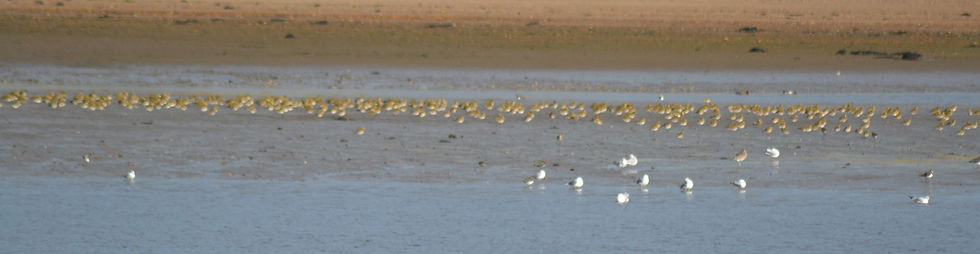
Golden Plover on the Coquet estuary in Northumberland


Comments